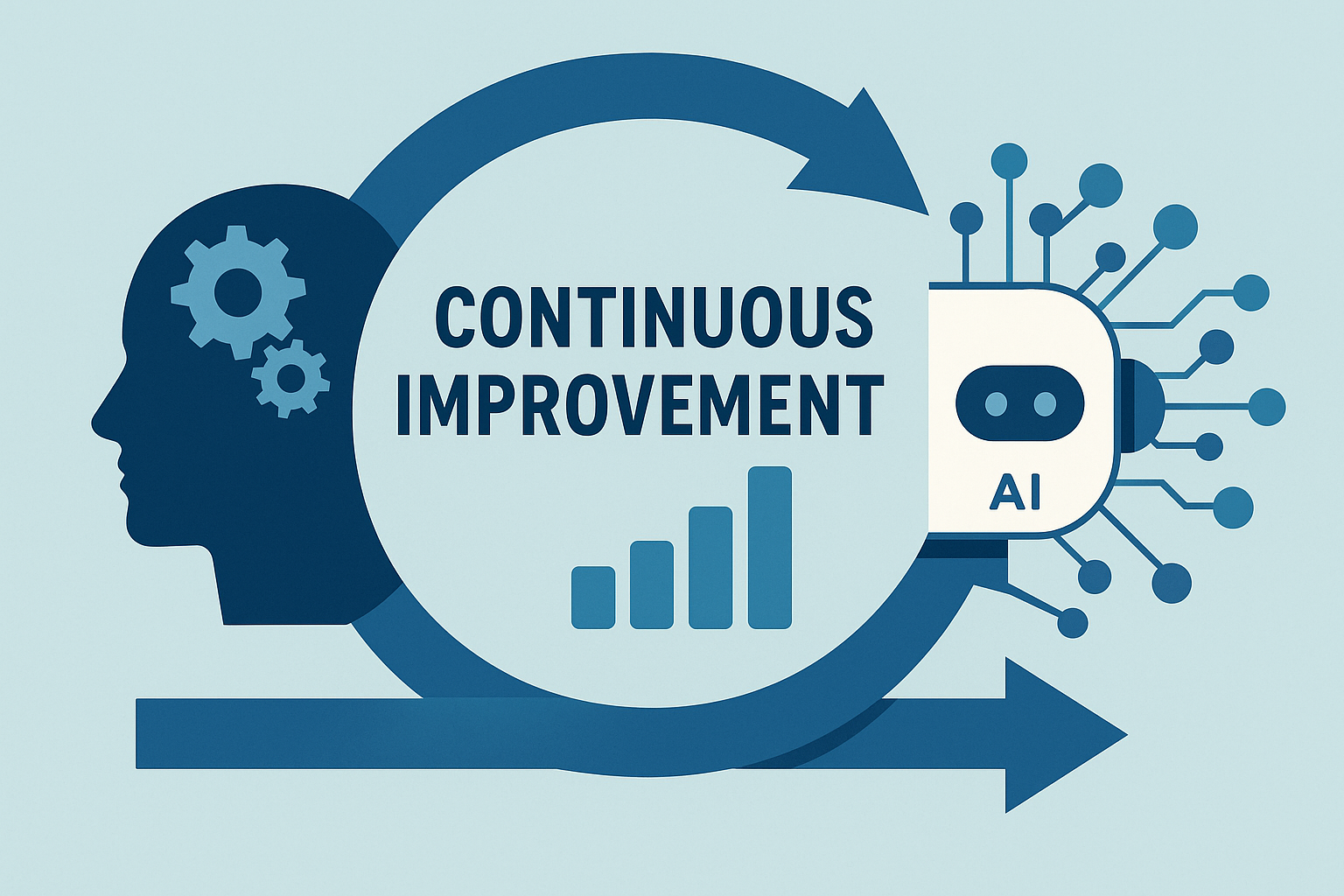
TL;DR: Kaizen — the principle of continuous improvement — isn’t fading in the era of AI. It’s evolving. By combining traditional process discipline with automation, data analytics, and AI-driven insights, organizations can achieve improvement cycles that are faster, smarter, and truly continuous.
For decades, Kaizen has stood as one of the most powerful principles in operational excellence: the belief that small, consistent improvements compound into extraordinary results. But what happens when algorithms start suggesting those improvements?
Welcome to Kaizen 2.0 — the evolution of continuous improvement in the age of AI.
Classic Kaizen thrives on human observation — employees spotting inefficiencies and proposing incremental fixes. This mindset still matters. But the scale and speed of modern operations now demand a new partner: data.
AI, automation, and machine learning can process thousands of signals humans can’t see. They don’t replace the Kaizen philosophy — they amplify it.
This isn’t about discarding Lean or Kaizen principles. It’s about enhancing them with tools that see, learn, and act faster than humans alone ever could.
The American Society for Quality (ASQ) calls this new convergence Quality 4.0 — where traditional quality and continuous improvement frameworks meet AI, automation, and advanced analytics.
Quality 4.0 builds on three pillars:
As one expert noted: “The core principles of continuous improvement remain vital — they just must evolve.” The goal hasn’t changed. Only the toolkit has.
AI doesn’t replace the human mindset behind Kaizen — it accelerates it. Here’s how:
Machine learning algorithms can detect inefficiencies automatically — identifying patterns in delays, handoffs, or system usage that humans might miss.
Example: In manufacturing, AI models analyze sensor data to predict equipment wear and schedule maintenance before breakdowns occur. It’s Kaizen, but proactive — improvement before failure.
AI agents can act as autonomous problem-solvers, resolving simple issues instantly and escalating complex ones with full context. This means problems aren’t just identified — they’re fixed in real time.
Example: A global logistics firm uses AI agents to detect delayed shipments, reroute deliveries, and notify customers automatically. The process continually improves with each iteration.
In Six Sigma and Kaizen, root cause analysis is key — but it’s often slow and manual. AI automates this by identifying correlations across vast datasets and surfacing root causes instantly.
Example: A SaaS company used AI to analyze support tickets and found 30% of delays stemmed from one outdated API dependency — something manual review missed for months.
Even as AI drives new efficiencies, the human side of Kaizen remains irreplaceable.
Continuous improvement still depends on:
AI delivers the data — but humans decide what “better” looks like.
The best organizations foster a collaborative improvement loop where AI surfaces opportunities, teams interpret and implement them, and feedback refines the models.
Imagine a mid-sized manufacturer applying Kaizen 2.0 principles:
Over time, the process learns. Each cycle becomes faster, smarter, and more precise.
Companies adopting similar models report:
Kaizen 2.0 blends timeless principles with modern capabilities. Here’s what the toolkit looks like:
| Purpose | Modern Tools |
|---|---|
| Process Mapping & Visibility | Mello, Lucidchart, Airtable |
| Automation & AI Agents | Mello, Tonkean, n8n |
| Data Analytics & Root Cause | Power BI, Tableau, Google Vertex AI |
| Collaboration & Feedback | Slack, Microsoft Teams |
The goal isn’t to replace human insight — it’s to amplify it through better information and automation.
Kaizen isn’t obsolete — it’s evolving. The mindset that powered decades of efficiency now has a digital ally.
By combining human creativity with machine precision, organizations can achieve true continuous improvement — where progress isn’t scheduled for quarterly reviews, but happens in real time.
That’s Kaizen 2.0: a philosophy powered by people, perfected by data, and accelerated by AI.