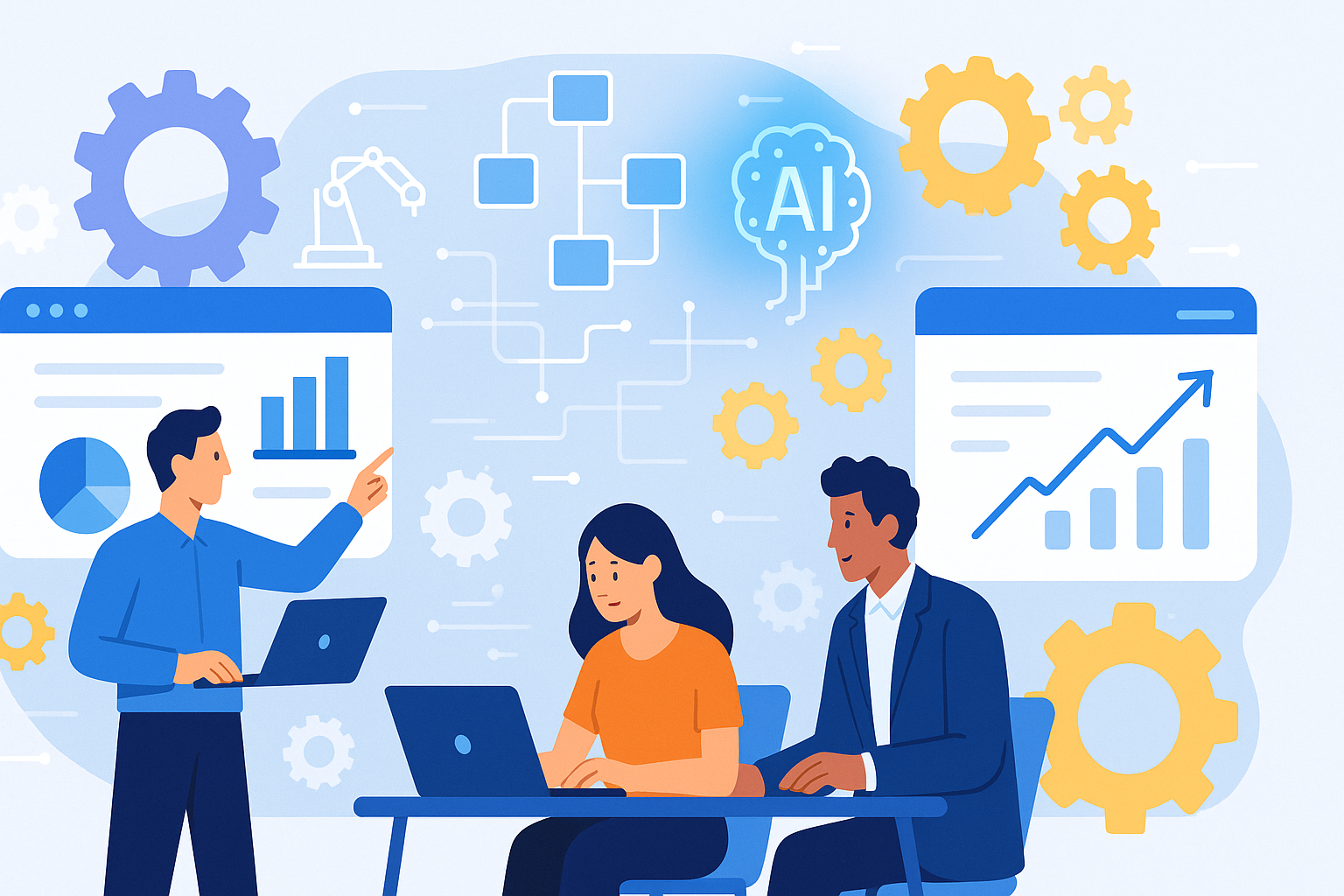
TL;DR: Scaling your organization doesn’t always mean growing your team. By standardizing processes, eliminating low-value work, and leveraging automation and AI, operations leaders can double productivity without adding headcount — and create a more agile, resilient organization in the process.
Every operations leader today faces the same mandate: do more with less. Budgets are tightening, hiring freezes are common, and efficiency has become the new growth metric.
But scaling operations doesn’t have to mean expanding your team. The most efficient companies are scaling output — not payroll — by combining smarter processes, automation, and a culture of continuous improvement.
This playbook outlines practical, evidence-backed strategies to help you increase organizational throughput and impact without increasing headcount.
Traditional scaling used to mean adding people. But in the digital age, that equation no longer holds.
According to DocuPhase, staying competitive now means “doing more with less” — because budgets no longer support constant headcount growth. Meanwhile, automation and AI tools have made it possible to achieve exponential output without linear cost increases.
The takeaway? Scaling isn’t about hiring faster — it’s about removing friction from how work happens.
Before adding automation or AI, start by simplifying and standardizing your processes. You can’t automate chaos.
Standardization creates consistency, reduces errors, and makes processes easier to measure and improve. It also ensures every employee works from the same playbook — critical for teams trying to scale efficiently.
How to do it:
Once your workflows are standardized, automation can amplify their efficiency tenfold.
Example: A regional HR team standardized its onboarding process across offices before introducing digital workflows. The result? A 40% reduction in onboarding time and zero missed compliance steps.
Scaling starts with subtraction. Identify and remove tasks that don’t contribute to strategic goals.
Low-value work — manual data entry, redundant reporting, unnecessary meetings — drains productivity and morale. Automating or eliminating these activities frees your team for higher-value work.
How to do it:
Example: A finance operations team used automation to eliminate manual report compilation. Instead of spending 10 hours weekly consolidating spreadsheets, dashboards now refresh automatically — saving over 500 hours annually.
AI is no longer just for IT teams — it’s now a competitive necessity across every business function.
The best-performing organizations integrate AI into routine workflows, from expense reconciliation to customer escalations. Generative AI tools augment teams, not replace them, freeing capacity for strategic problem-solving.
Key applications include:
Evidence: Glean’s research found teams using AI-driven assistants to automate repetitive knowledge tasks improved throughput by 66% on average.
Example: A SaaS company used AI to summarize customer feedback, categorize support tickets, and auto-generate product insights — reducing time-to-action by 60% while improving accuracy.
Sustainable scaling isn’t just about technology — it’s about mindset. Encourage every team member to identify inefficiencies and suggest improvements.
Lean and Kaizen principles still hold power: small, continuous changes lead to massive long-term gains. Equip teams with the autonomy and tools to fix what slows them down.
How to do it:
Example: A global logistics firm empowered employees to suggest automation candidates each quarter. Over a year, they automated 27 manual processes — freeing 15% of team capacity without layoffs.
You can’t scale what you can’t see.
When data is scattered across tools and teams, leaders lose visibility into what’s working and what’s slowing growth. Integrating systems and dashboards creates a single source of truth for performance and process health.
How to do it:
Example: A mid-market manufacturer integrated their CRM, ERP, and procurement tools to create a unified operations dashboard. This eliminated double-entry and helped leaders spot delays instantly — reducing cycle times by 35%.
Scaling efficiently requires a blend of process design, technology, and culture. Here’s what modern operations teams use to make it happen:
| Category | Tools |
|---|---|
| Workflow Automation | Mello, Nintex, Kissflow |
| Integration Platforms | n8n, Zapier, Make |
| Project Visibility | Asana, ClickUp, Airtable |
| Data & Analytics | Power BI, Tableau, Google Looker |
| Collaboration | Slack, Microsoft Teams |
These tools act as the force multipliers that let small teams punch above their weight.
To scale without hiring, combine these strategies into a cohesive framework:
Together, these create a self-improving operational system — one where growth doesn’t depend on headcount.
Scaling used to mean hiring. Now it means optimizing.
By redesigning workflows, embracing automation, and empowering teams to drive efficiency, you can double throughput without adding a single new employee.
In a world where budgets are tight and expectations are high, the winning organizations aren’t the ones that grow fastest — they’re the ones that operate smartest.
Efficiency isn’t a constraint. It’s a competitive advantage.